


Outdoor Advertising: The Evolving Expectations of CFOs
For years, outdoor advertising was built on trust. Advertisers and CFOs trusted that the locations were busy. They trusted the message was seen. They also trusted the impression numbers.
That worked when data was limited. People accepted assumptions. But today, CFOs do not accept guesswork.
Now, brands expect proof. Real-time tracking is normal in most channels. Every spend needs evidence. Outdoor advertising has not fully caught up.
This creates a clear gap. Outdoor is often sold in the old way. CFOs measure ROI the modern way.
A big reason is the “pray and spray” mindset. Brands buy space, put up a message, and hope it works.
In this article, we explain why that approach hurts ROI. We also explain why visibility claims are not enough anymore. Finally, we share how to measure results more clearly.
 What is “Pray and Spray” and Why is It a Financial Risk?
Why Visibility Claims Fail Under Scrutiny
“High visibility” and “premium exposure” are phrases commonly used in the outdoor advertising world. While they sound reassuring, they don’t hold up in boardroom discussions where hard data is king.
CFOs want answers to tough questions like:
- Was the ad displayed every day?
- Was the message actually visible at the right time?
- What was the verified exposure?
- How does this compare to other marketing channels?
Visibility claims don’t provide the answers. They only suggest potential. They don’t tell CFOs exactly what happened during the campaign.
When it comes to financial reporting, estimates and assumptions are no longer sufficient. For CFOs, data-driven decisions require certainty, and outdoor advertising that relies on estimates introduces unnecessary risks.
The Real Cost of Assumptions in Outdoor Advertising
The consequences of working with assumptions can be severe, especially when budgets are under pressure.
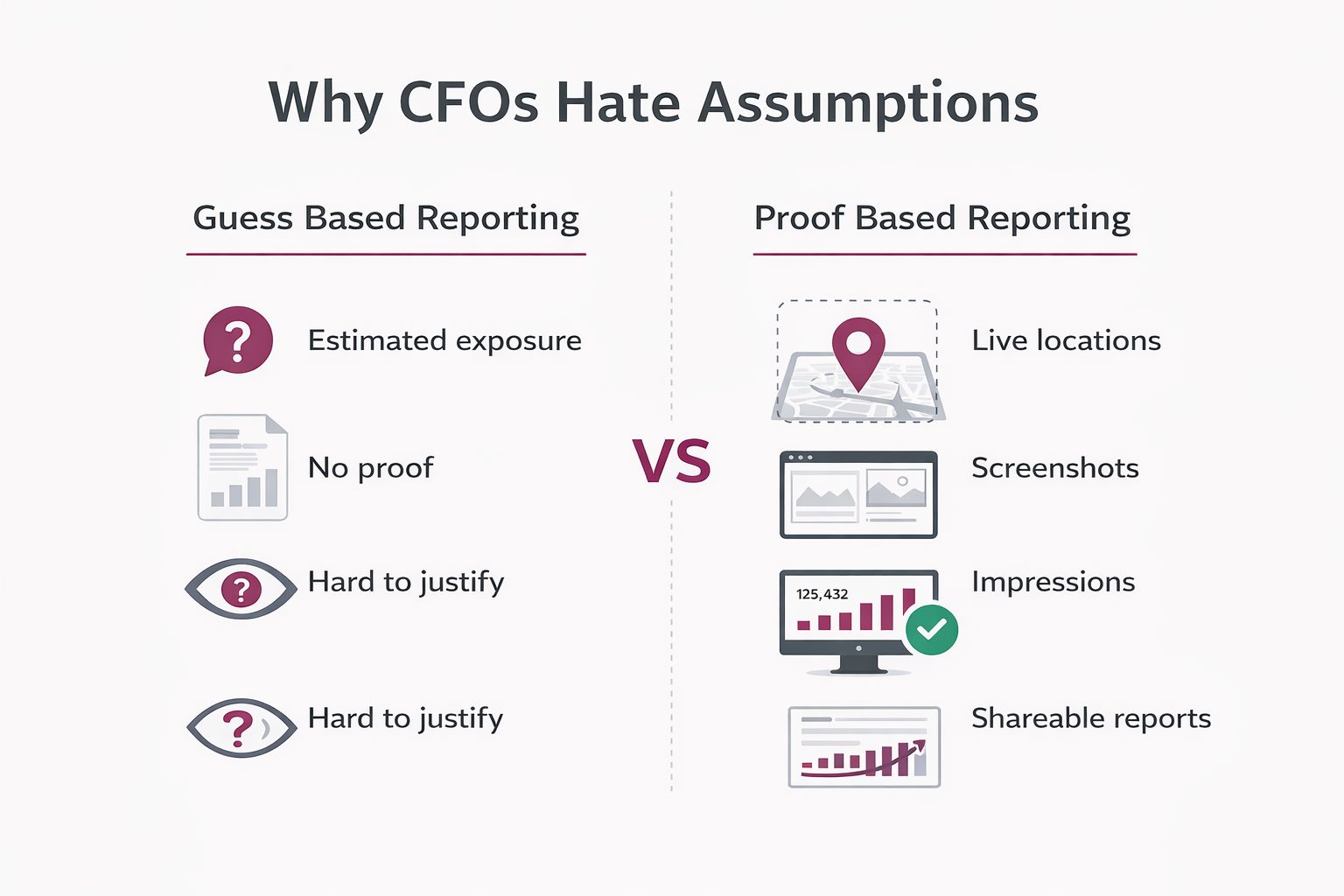
When CFOs can’t trace outcomes to clear proof, marketing spend becomes vulnerable to cuts. It’s not that the channel didn’t work, but without the proof to justify the investment, it becomes difficult to defend outdoor advertising as a strategic, revenue-generating investment.
This is why the “pray and spray” approach erodes long-term ROI. Even if a campaign delivers value, the lack of proof makes it difficult to recognize, repeat, or scale that value. Over time, this weakens trust between finance and marketing, with outdoor advertising seen as an expense rather than an investment.
The Digital Transformation: How CFOs Now Expect Advertising to Be Measured
Digital advertising has raised the standard for accountability. In digital channels, results are easy to measure. You can track a campaign with clear start and end times.
Impressions are recorded in real time. Results show up fast. For CFOs, this is now the baseline expectation for any ad spend.
Outdoor advertising faces a problem here. It often uses older reporting methods. That makes it hard for CFOs to compare outdoor results with modern digital channels that offer clear proof.
To measure outdoor advertising ROI today, outdoor needs the same level of tracking and transparency that digital channels already use.
The Key to Measuring ROI: Verification, Consistency, and Transparency
True ROI measurement requires three essential elements:
- Verification: Knowing that the campaign ran as planned, not assumed.
- Consistency: Understanding how exposure was delivered across different days and locations.
- Transparency: Providing access to data that finance teams can review, verify, and trust.
Without these elements, discussions about ROI remain theoretical. When these elements are in place, outdoor advertising can be measured in the same language as digital advertising, making it easier to justify and optimize.
Why Estimated Impressions Aren’t Enough Anymore
Estimated impressions were useful at a time when tracking was impossible. But today’s CFOs know the difference between modeled numbers and actual data. One is an assumption, and the other is evidence.
Most estimated impressions are based on traffic studies, population density, and assumed attention. They don’t account for real movement patterns, operational gaps, or ad downtime. For CFOs, assumptions in ROI calculations weaken confidence in the accuracy of results, even if the campaign has a real-world impact.
Moving From Exposure to Proof
The future of outdoor advertising is about proof, not louder claims.
With real-time tracking and verified performance data, campaigns can show exactly when they ran, where they appeared, and how exposure accumulated over time. This kind of data gives CFOs the clarity they need to confidently assess the value of the campaign, while marketing teams gain the credibility they need to justify their budget.
This shift from exposure to proof allows organizations to move from problem-aware to solution-aware. The problem isn’t outdoor advertising; it’s unverified outdoor advertising. The solution is bringing transparency, verification, and consistency into outdoor campaigns.
Bridging the Measurement Gap: New Systems for Accountability
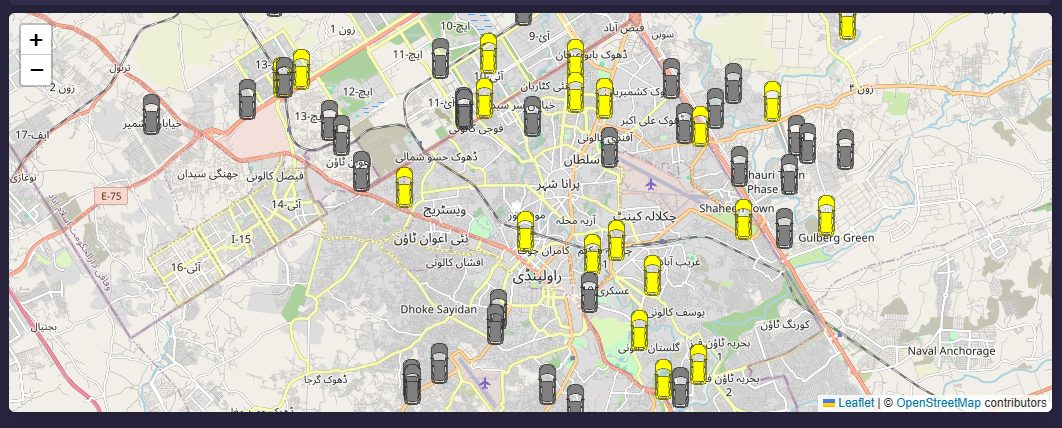
New systems are now mixing real-world visibility with digital-level proof. They track what ran, where it ran, and when it ran. Some even give visual proof through campaign screenshots. This uses real data instead of assumptions. It helps outdoor advertising match the same accountability standards people expect from digital ads.
Minute Marketing is one example of this shift. We provide real-time tracking and reporting for outdoor campaigns. With dashboard access, clients can see where their ads appeared and when they appeared. They can also review campaign screenshots and track delivery across the campaign days. This gives CFOs clear proof to justify spending and improve results.
Reframing How CFOs Should Measure Advertising ROI
To move forward, CFOs need to reframe the question. Instead of asking if outdoor advertising works, they should be asking if it can be properly measured. Instead of relying on estimated impressions, CFOs should demand verification. Instead of trusting visibility claims, they should ask for data on delivery and exposure.
This shift in mindset doesn’t eliminate outdoor advertising—it strengthens it. Channels that can prove value will survive budget scrutiny, while those that resist these new standards will continue to lose share.
The End of Guesswork in Outdoor Advertising
“Pray and spray” is hurting outdoor advertising ROI because it depends on hope. Today, CFOs want evidence. They need clear proof, steady delivery, and full transparency. Not claims. Not assumptions.
Outdoor advertising performs best when it can be verified. The strongest models now offer proof of delivery, real-time tracking, and verified exposure. That is how brands move from guesswork to measurable results you can defend in a budget review.
If your organization is rethinking outdoor advertising, ask one simple question. Can this channel show proof, not promises? Your answer will shape your ROI.
Start measuring your outdoor advertising campaigns with confidence. For a demo of Minute Marketing’s data-driven outdoor advertising platform, contact us.
Phone: 0333 0500300
Website: Minute Marketing
LinkedIn: Minute Marketing LinkedIn
